


Key Takeaways
- Residential electricians work primarily in homes and residential properties.
- Commercial electricians work in businesses, facilities, and commercial buildings.
- The main differences involve work environment, project size, and electrical systems.
- Residential work may appeal to people who enjoy customer interaction and variety.
- Commercial work may suit people who prefer larger projects and construction teams.
- Both paths require safety, technical knowledge, troubleshooting, and hands-on skills. Your first electrical job does not have to determine your entire career.
- The right path depends on your skills, interests, and career goals.
- Electrical training can help you explore residential, commercial, and renewable energy opportunities.
Electricity is everywhere, but electrical work does not look the same on every job.
An electrical technician working inside a newly constructed home may spend the day installing circuits, outlets, lighting, and other residential electrical components. Another electrician may be working on a large commercial construction project with multiple systems, crews, plans, and building requirements.
That is why students researching a career in the electrical trades often come across the question:
What is the difference between residential vs commercial electrician work?
The answer matters because your preferred work environment, personality, learning style, and long-term goals can all influence which path feels like the better fit.
For someone considering electrical technology training, this isn't simply a question of choosing between two job titles. It is about understanding the kinds of projects you may encounter, the skills you will need, and the type of workday you would enjoy.
This guide breaks down the residential vs commercial electrician career paths so you can make a more informed decision before investing your time in training.
An electrical technician working inside a newly constructed home may spend the day installing circuits, outlets, lighting, and other residential electrical components. Another electrician may be working on a large commercial construction project with multiple systems, crews, plans, and building requirements.
That is why students researching a career in the electrical trades often come across the question:
What is the difference between residential vs commercial electrician work?
The answer matters because your preferred work environment, personality, learning style, and long-term goals can all influence which path feels like the better fit.
For someone considering electrical technology training, this isn't simply a question of choosing between two job titles. It is about understanding the kinds of projects you may encounter, the skills you will need, and the type of workday you would enjoy.
This guide breaks down the residential vs commercial electrician career paths so you can make a more informed decision before investing your time in training.
What Is a Residential Electrician?
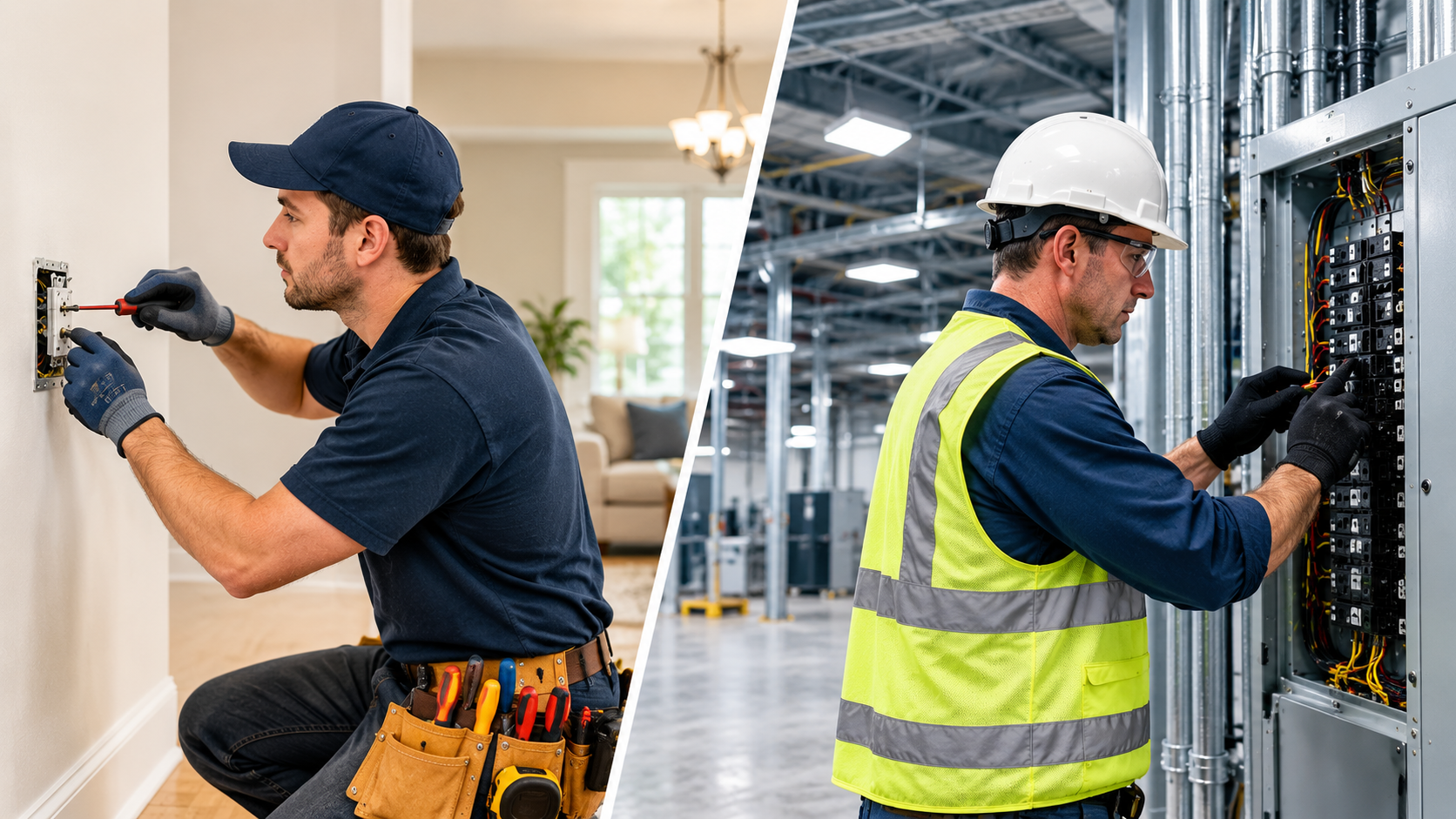
A residential electrician focuses primarily on electrical systems used in homes and other residential properties. The work can involve new construction, renovations, repairs, installations, maintenance, and troubleshooting.
Residential electrical work can be appealing to people who enjoy variety. One day may involve helping install electrical components in a new home, while another may involve diagnosing an electrical problem for a homeowner.
The environment is also different from many large commercial projects. Instead of spending every day on a major construction site, residential electricians may work in houses, apartments, townhomes, and other living spaces.
For students, residential work can be an approachable way to understand how electrical systems operate in real-world settings. You can see how electrical concepts learned during training connect to practical applications.
It also requires strong communication skills. When working in someone's home, an electrician is not only dealing with wiring and equipment. The electrician is also interacting with a customer who may not understand the technical problem. That combination of technical knowledge, troubleshooting, safety, and communication can make residential electrical work a good fit for someone who likes solving problems while working directly with people.
Residential electrical work can be appealing to people who enjoy variety. One day may involve helping install electrical components in a new home, while another may involve diagnosing an electrical problem for a homeowner.
The environment is also different from many large commercial projects. Instead of spending every day on a major construction site, residential electricians may work in houses, apartments, townhomes, and other living spaces.
For students, residential work can be an approachable way to understand how electrical systems operate in real-world settings. You can see how electrical concepts learned during training connect to practical applications.
It also requires strong communication skills. When working in someone's home, an electrician is not only dealing with wiring and equipment. The electrician is also interacting with a customer who may not understand the technical problem. That combination of technical knowledge, troubleshooting, safety, and communication can make residential electrical work a good fit for someone who likes solving problems while working directly with people.
What Is a Commercial Electrician?
Commercial electricians work on electrical systems in commercial buildings and other non-residential environments.
That can include places such as offices, retail buildings, facilities, and other business properties. Commercial projects can be larger in scale than many residential jobs and may involve working as part of a construction or electrical crew.
Commercial electrical work can require technicians to understand electrical plans, coordinate with other trades, work around construction schedules, and follow detailed project requirements.
For someone considering the residential vs commercial electrician question, the work environment may be one of the most important differences to consider.A commercial job may place you on a larger construction site where several professionals are working at the same time. Communication and coordination can therefore become a major part of the job.
Commercial electrical work may also appeal to people who enjoy seeing a project develop from an early construction stage into a finished building.
For a student who likes larger projects, construction environments, teamwork, and technical problem-solving, commercial electrical work may be an especially interesting direction.
ACI's electrical training certificate program materials also identify commercial electric and solar as areas of interest for prospective students, reflecting the broader range of opportunities students may want to explore as they build their electrical skills.
That can include places such as offices, retail buildings, facilities, and other business properties. Commercial projects can be larger in scale than many residential jobs and may involve working as part of a construction or electrical crew.
Commercial electrical work can require technicians to understand electrical plans, coordinate with other trades, work around construction schedules, and follow detailed project requirements.
For someone considering the residential vs commercial electrician question, the work environment may be one of the most important differences to consider.A commercial job may place you on a larger construction site where several professionals are working at the same time. Communication and coordination can therefore become a major part of the job.
Commercial electrical work may also appeal to people who enjoy seeing a project develop from an early construction stage into a finished building.
For a student who likes larger projects, construction environments, teamwork, and technical problem-solving, commercial electrical work may be an especially interesting direction.
ACI's electrical training certificate program materials also identify commercial electric and solar as areas of interest for prospective students, reflecting the broader range of opportunities students may want to explore as they build their electrical skills.
Residential vs Commercial Electrician: What Is the Main Difference?
The simplest way to understand residential vs commercial electrician work is to look at where the electrician works and the systems involved.
Residential electricians primarily work with electrical systems in homes and residential properties. Commercial electricians primarily work with electrical systems in business and commercial environments.
However, the distinction goes beyond the building itself.
Residential projects may involve more direct interaction with homeowners, property owners, or residents. Commercial projects may involve general contractors, construction crews, project managers, business owners, facility personnel, and other trades.
The size of the project can also differ. A residential electrician might focus on a single home or a specific repair. A commercial electrician may contribute to a much larger construction or renovation project.
The equipment, plans, installation requirements, and project coordination can vary as well. That does not mean one path is automatically better than the other.
Instead, think about the kind of work that makes you curious.
Would you rather walk into a home and figure out why a particular electrical system isn't working correctly? Or would you rather work with a crew building the electrical infrastructure for a large commercial property?
Your answer can tell you a lot about which direction may fit you best.
Residential electricians primarily work with electrical systems in homes and residential properties. Commercial electricians primarily work with electrical systems in business and commercial environments.
However, the distinction goes beyond the building itself.
Residential projects may involve more direct interaction with homeowners, property owners, or residents. Commercial projects may involve general contractors, construction crews, project managers, business owners, facility personnel, and other trades.
The size of the project can also differ. A residential electrician might focus on a single home or a specific repair. A commercial electrician may contribute to a much larger construction or renovation project.
The equipment, plans, installation requirements, and project coordination can vary as well. That does not mean one path is automatically better than the other.
Instead, think about the kind of work that makes you curious.
Would you rather walk into a home and figure out why a particular electrical system isn't working correctly? Or would you rather work with a crew building the electrical infrastructure for a large commercial property?
Your answer can tell you a lot about which direction may fit you best.
How Are the Work Environments Different?
Work environment is one of the most practical factors to consider when comparing residential vs commercial electrician careers.
Residential electricians commonly work in homes and other residential spaces. The work may involve entering occupied properties, communicating with homeowners, moving through smaller work areas, and adapting to the conditions of an existing building.
Commercial electricians may spend more time on construction sites, commercial facilities, and larger buildings. These environments can involve multiple crews working simultaneously and may require closer coordination with other construction professionals.
Think about how you prefer to work.
If you like variety, direct customer interaction, and moving from one residential project to another, residential work may be attractive.
If you like construction sites, larger teams, structured projects, and seeing major buildings take shape, commercial work may be more appealing.
Neither environment is universally easier.
Both require professionalism, patience, safety awareness, and the ability to solve problems when conditions do not go exactly as planned. For prospective students, it is useful to remember that electrical training is not only about memorizing terminology. You are preparing to work in physical environments where careful decisions and practical skills matter.
Residential electricians commonly work in homes and other residential spaces. The work may involve entering occupied properties, communicating with homeowners, moving through smaller work areas, and adapting to the conditions of an existing building.
Commercial electricians may spend more time on construction sites, commercial facilities, and larger buildings. These environments can involve multiple crews working simultaneously and may require closer coordination with other construction professionals.
Think about how you prefer to work.
If you like variety, direct customer interaction, and moving from one residential project to another, residential work may be attractive.
If you like construction sites, larger teams, structured projects, and seeing major buildings take shape, commercial work may be more appealing.
Neither environment is universally easier.
Both require professionalism, patience, safety awareness, and the ability to solve problems when conditions do not go exactly as planned. For prospective students, it is useful to remember that electrical training is not only about memorizing terminology. You are preparing to work in physical environments where careful decisions and practical skills matter.
What Skills Do Residential Electricians Need?
Residential electrical work requires a strong foundation in electrical concepts and practical problem-solving. A residential electrician needs to understand how electrical systems work, how components connect, how to work safely, and how to identify potential problems.
Attention to detail is especially important. Electrical work is not an area where guessing is a good strategy.
Residential electricians can also benefit from strong communication skills. Homeowners may describe a problem using everyday language rather than technical terms. The electrician needs to listen, ask useful questions, identify the issue, and explain the solution clearly.
Other valuable skills include:
Attention to detail is especially important. Electrical work is not an area where guessing is a good strategy.
Residential electricians can also benefit from strong communication skills. Homeowners may describe a problem using everyday language rather than technical terms. The electrician needs to listen, ask useful questions, identify the issue, and explain the solution clearly.
Other valuable skills include:
- Reading basic electrical information and diagrams
- Using electrical tools correctly
- Following safety procedures
- Troubleshooting electrical problems
- Understanding circuits and components
- Working carefully in confined spaces
- Communicating with customers
- Maintaining organized work habits
ACI's electrical and renewable energy training is positioned for students interested in residential electrical systems as well as solar energy applications, giving students a foundation connected to practical trade work.
What Skills Do Commercial Electricians Need?
Commercial electricians need many of the same fundamental electrical skills as residential electricians, but the work environment can introduce additional demands. Commercial projects can involve larger buildings, multiple trades, detailed project plans, and coordinated construction schedules. That means communication and teamwork can become particularly important.
A commercial electrician may need to understand drawings, follow project specifications, coordinate work with other professionals, and maintain safety standards while working on a busy job site.
Important skills can include:
A commercial electrician may need to understand drawings, follow project specifications, coordinate work with other professionals, and maintain safety standards while working on a busy job site.
Important skills can include:
- Electrical theory and fundamentals Blueprint and diagram reading
- Equipment setup and proper tool use Electrical troubleshooting
- Safety procedures
- Job-site communication
- Teamwork
- Attention to detail
- Time management
- Ability to follow project specifications
- The ability to learn is also important.
Electrical technology continues to change. Students interested in solar energy and renewable energy systems, for example, may want to develop skills beyond traditional electrical applications.
That is one reason the electrical field can be attractive to someone who wants a career where there is room to continue learning.
For students who enjoy larger projects and working with a team, commercial electrical work can offer a different experience from residential service work.
Can You Start in Residential and Move Into Commercial Work?
Your first electrical job does not necessarily have to define your entire career. Many people enter a skilled trade by building foundational knowledge and practical experience first, then expanding their skills as their careers develop.
That makes training especially important. A student should look for education that develops fundamental electrical knowledge rather than focusing only on a narrow task.
Austin Career Institute, the Electrical & Renewable Energy program is designed around residential and solar energy systems and is intended for students interested in building a practical electrical career. The program also aligns with the interests of students who want to explore areas such as commercial electric and renewable energy.
For someone researching residential vs commercial electrician careers, this broader perspective matters. You may begin with one area of electrical work and later discover that another environment suits you better. Your interests can change as you gain experience.
Perhaps you begin by enjoying residential troubleshooting and later become interested in commercial construction. Or you may discover that residential service work is exactly what you wanted. Training gives you the foundation. Experience helps you determine where you want to take it.
That makes training especially important. A student should look for education that develops fundamental electrical knowledge rather than focusing only on a narrow task.
Austin Career Institute, the Electrical & Renewable Energy program is designed around residential and solar energy systems and is intended for students interested in building a practical electrical career. The program also aligns with the interests of students who want to explore areas such as commercial electric and renewable energy.
For someone researching residential vs commercial electrician careers, this broader perspective matters. You may begin with one area of electrical work and later discover that another environment suits you better. Your interests can change as you gain experience.
Perhaps you begin by enjoying residential troubleshooting and later become interested in commercial construction. Or you may discover that residential service work is exactly what you wanted. Training gives you the foundation. Experience helps you determine where you want to take it.
What Should You Look for in Electrical Technician Training?
Choosing the right training program is an important step because your education should help you build skills that apply beyond the classroom. Look for training that emphasizes practical knowledge, safety, electrical fundamentals, and real-world applications.
Hands-on learning is particularly important for a technical trade. You want opportunities to connect what you learn in theory with how electrical equipment and systems actually work. You should also understand what the program covers before enrolling.
Ask questions such as:
Hands-on learning is particularly important for a technical trade. You want opportunities to connect what you learn in theory with how electrical equipment and systems actually work. You should also understand what the program covers before enrolling.
Ask questions such as:
- What electrical topics are included?
- How much hands-on training is provided?
- What equipment will students work with?
- Does the curriculum address residential electrical systems?
- Are renewable energy or solar applications included?
- What career pathways can the training support?
- What are the program's scheduling options?
- What support is available to students?
For students who are concerned about spending years in school, the goal should be to find training that is focused, practical, and connected to the career they want to pursue.
Is Electrical Technology a Good Career Direction for You?
If you want a career built around practical skills, problem-solving, and technical knowledge, electrical technology may be worth exploring.
The field can appeal to people who do not want to spend their workday behind a desk. The buyer persona developed for ACI's electrical program, for example, describes a prospective student who wants a dependable career, enjoys physical skill and trade mastery, and is interested in opportunities such as solar and commercial electric. That student may also be coming from gig work, light construction, delivery, or another job with inconsistent hours. For someone in that situation, the decision to pursue training is about more than learning a technical skill. It can be about creating a clearer career direction.
If that sounds familiar, start by learning what the work actually involves.
Research residential and commercial electrical careers. Look at the training available. Talk with instructors. Ask about hands-on experience. Think about the work environment you would enjoy. You do not have to know exactly where you will be five or ten years from now.
You need a starting point.
The field can appeal to people who do not want to spend their workday behind a desk. The buyer persona developed for ACI's electrical program, for example, describes a prospective student who wants a dependable career, enjoys physical skill and trade mastery, and is interested in opportunities such as solar and commercial electric. That student may also be coming from gig work, light construction, delivery, or another job with inconsistent hours. For someone in that situation, the decision to pursue training is about more than learning a technical skill. It can be about creating a clearer career direction.
If that sounds familiar, start by learning what the work actually involves.
Research residential and commercial electrical careers. Look at the training available. Talk with instructors. Ask about hands-on experience. Think about the work environment you would enjoy. You do not have to know exactly where you will be five or ten years from now.
You need a starting point.
FAQ: Residential vs Commercial Electrician
What is the difference between a residential and commercial electrician?
The main difference is the type of property and electrical environment where the electrician works. Residential electricians primarily work on homes and residential properties, while commercial electricians work on business, office, retail, facility, and other commercial properties. The projects, work environments, customers, and level of coordination can differ.
Is residential electrical work easier than commercial electrical work?
Not necessarily. Residential and commercial electrical work involve different challenges. Residential electricians may deal with individual customer needs, existing homes, repairs, and troubleshooting. Commercial electricians may work on larger projects, construction sites, detailed plans, and coordinated crews. Neither path should be viewed as simply "easy" or "hard."
Can an electrician work in both residential and commercial settings?
Career experience can develop in different directions, and electricians may build skills that allow them to pursue different areas of electrical work. The specific requirements for performing electrical work depend on the applicable licensing and regulatory rules, so students should research the requirements for their location and intended career path.
Which is better for a beginner: residential or commercial electrical work?
There is no universal answer. Residential work may appeal to someone who likes direct customer interaction and solving individual problems. Commercial work may be more attractive to someone who prefers larger construction projects and teamwork. A strong electrical training foundation can help you determine which environment fits you best.
What should I learn before becoming an electrician?
Start with electrical fundamentals, safety, tools, troubleshooting, and practical applications. Training should help you understand how electrical systems work and give you opportunities to apply that knowledge in hands-on settings.
Is solar energy part of the electrical field?
Yes, solar energy systems are an area of interest within electrical technology. Students interested in renewable energy should look for training that specifically addresses solar or renewable energy applications. ACI's Electrical & Renewable Energy program includes residential and solar energy systems as part of its focus.
Do I need to know whether I want residential or commercial work before enrolling?
No. It is helpful to understand the differences, but you do not necessarily need to have your entire career mapped out before starting training. Your interests may become clearer as you learn electrical fundamentals and gain practical experience.
How do I know if electrical technology is right for me?
Consider whether you enjoy hands-on work, problem-solving, technical subjects, learning how systems work, and working with tools. You should also consider whether you prefer working indoors, on construction sites, with customers, or as part of a larger team. Talking with an experienced instructor can also help you understand what the work is really like.
Ready to Take the Next Step Toward an Electrical Career?
Choosing between a residential vs commercial electrician career is an important decision—but you don't have to have your entire career mapped out before you get started.
The best place to begin is by building a strong foundation in electrical skills and gaining a better understanding of where those skills can take you. Whether you're interested in residential electrical work, commercial projects, solar energy, or other opportunities in the skilled trades, the right training can help you take that first step with confidence.
At Austin Career Institute, our Electrical & Renewable Energy program is designed for students who want practical training in residential electrical and solar energy systems. You'll develop skills that can help prepare you to pursue opportunities in the growing electrical field.
If you're ready to turn your interest in electrical technology into a career plan, explore the Electrical & Renewable Energy program at Austin Career Institute and discover your next step.
You don't need to know exactly where your career will take you. You just need to be ready to start building the skills that can take you there.
The best place to begin is by building a strong foundation in electrical skills and gaining a better understanding of where those skills can take you. Whether you're interested in residential electrical work, commercial projects, solar energy, or other opportunities in the skilled trades, the right training can help you take that first step with confidence.
At Austin Career Institute, our Electrical & Renewable Energy program is designed for students who want practical training in residential electrical and solar energy systems. You'll develop skills that can help prepare you to pursue opportunities in the growing electrical field.
If you're ready to turn your interest in electrical technology into a career plan, explore the Electrical & Renewable Energy program at Austin Career Institute and discover your next step.
You don't need to know exactly where your career will take you. You just need to be ready to start building the skills that can take you there.