

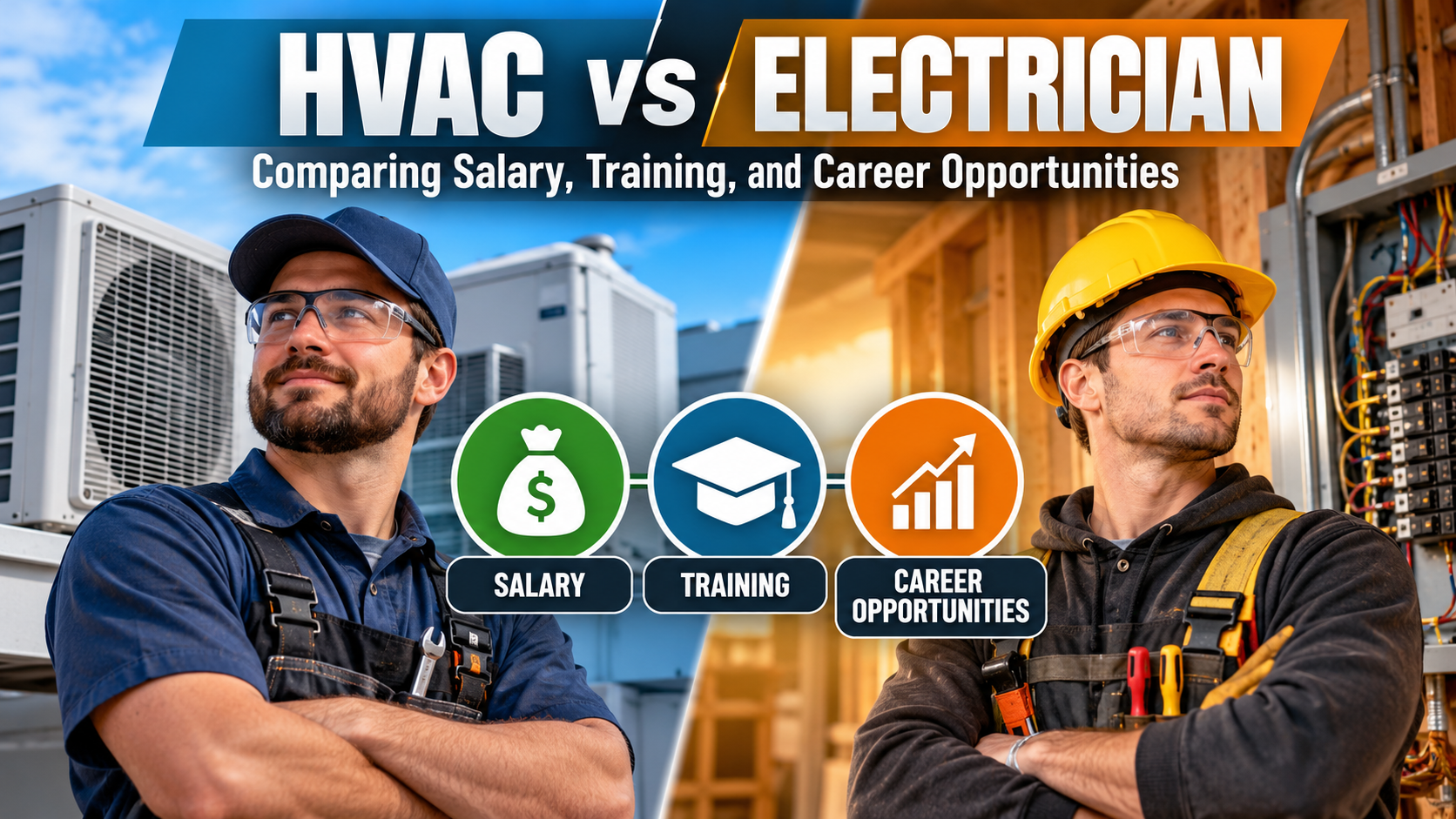

Key Takeaways
- Electricians currently have slightly higher national median pay.
- HVAC has the higher projected employment growth rate.
- Both careers involve technical, hands-on problem solving.
- HVAC combines mechanical, refrigeration, and electrical knowledge.
- Electricians specialize more deeply in electrical systems.
- Texas requires licensing for both career paths.
- Neither career normally requires a four-year degree.
- Your interests should matter more than salary alone.
At first glance, the careers may even seem similar. HVAC technicians work with equipment powered by electricity, while electricians regularly encounter motors, controls, equipment, and building systems.
But the day-to-day work is different.
HVAC technicians focus on heating, ventilation, air conditioning, and refrigeration systems. Electricians concentrate on wiring, electrical power, lighting, circuits, controls, and related electrical systems.
Salary isn't dramatically different at the national level, either. According to the U.S. Bureau of Labor Statistics, the median annual wage in May 2025 was $61,010 for HVAC mechanics and installers and $63,190 for electricians. Both occupations also have faster projected employment growth than the average for all occupations.
So how do you choose?
The answer depends on the type of problems you enjoy solving, the working environment you prefer, and the career path you want to build.
What Is the Difference Between HVAC and Electrical Work?
An HVAC technician works on systems that heat, cool, ventilate, or refrigerate spaces and products. Depending on the job, that can include residential air conditioners, furnaces, heat pumps, commercial cooling equipment, refrigeration systems, ductwork, controls, and related electrical components.
An electrician installs, maintains, and repairs electrical power, wiring, lighting, communications, and control systems. Electricians can work in homes, businesses, factories, construction projects, and industrial environments.
HVAC isn't purely mechanical. Modern heating and cooling equipment contains electrical circuits, motors, relays, capacitors, controls, sensors, and other electrical components. HVAC technicians therefore need to understand electricity well enough to diagnose and safely repair equipment.
The difference is one of emphasis.
An HVAC technician may ask:
Why isn't this air conditioner cooling properly? Finding the answer could require checking refrigerant conditions, airflow, electrical components, controls, or mechanical equipment.
An electrician might ask:
Why isn't this circuit receiving power? That investigation may involve wiring, breakers, connections, voltage, electrical loads, controls, or other parts of the electrical system.
Both careers reward people who like figuring out why something isn't working.
They simply lead you toward different kinds of systems.
HVAC vs Electrician Salary: Which Pays More?
Electricians currently have a modest advantage nationally.
The BLS reports that electricians earned a median annual wage of $63,190 in May 2025. The lowest 10% earned less than $42,640, while the highest 10% earned more than $108,510.
Heating, air conditioning, and refrigeration mechanics and installers earned a median annual wage of $61,010 in May 2025.
That's a difference of only about $2,180 per year between the national medians.
More importantly, a median wage isn't an entry-level salary guarantee.
Half of workers in an occupation earn more than the median and half earn less. What you personally earn can depend on experience, location, employer, specialty, industry, licensing, overtime, and the responsibilities you're qualified to handle.
For example, an apprentice electrician usually earns less than a fully trained electrician. BLS notes that apprentice pay generally rises as workers gain additional skills.
The same basic idea applies to HVAC.
A new technician and an experienced professional capable of diagnosing complex commercial refrigeration or HVAC systems aren't necessarily competing for the same positions or pay.
That makes salary useful when comparing careers—but not useful enough to make the decision by itself.
Instead, consider where each career can lead after several years of skill development.
HVAC vs Electrician Job Outlook
BLS projects employment for heating, air conditioning, and refrigeration mechanics and installers to grow 11% from 2025 through 2035, compared with 3% for all occupations. Approximately 40,600 openings are projected each year on average during that period.
Electrician employment is projected to grow 9% from 2025 through 2035. BLS expects approximately 72,700 electrician openings annually on average.
Those numbers tell two different stories.
HVAC has the higher percentage growth rate.
Electrical has the larger number of projected annual openings.
That's possible because electrician employment is a larger occupation nationally.
Why are both fields expected to need workers?
Buildings don't stop needing electricity, heating, cooling, ventilation, and refrigeration. Homes and businesses need new systems installed. Older equipment needs maintenance and replacement. New construction requires skilled workers. Existing buildings need upgrades.
Technology is also changing both trades.
HVAC equipment increasingly incorporates electronic controls, energy-efficiency technologies, and advanced diagnostic systems.
Electrical careers intersect with growing technologies such as renewable energy, photovoltaic systems, advanced controls, and changing power infrastructure.
For someone deciding between HVAC and electrical work, that's encouraging news: you're comparing two occupations with meaningful projected demand rather than choosing one growing field and one disappearing field.
HVAC Training vs Electrician Training
According to BLS, HVAC technicians typically need a postsecondary nondegree award, although some enter the occupation with less formal education. After being hired, technicians usually receive substantial on-the-job training before becoming fully competent. Licensing or certification requirements may also apply.
Electricians most commonly learn through an apprenticeship, although, more often now, they begin their preparation at a technical school.
A career-training program can provide a structured introduction to the technical skills before or alongside workplace experience.
Austin Career Institute's HVAC-R Technician program is designed as a short-term career-training pathway rather than a four-year college degree. ACI's program focuses on practical HVAC-R knowledge and skills for students preparing to enter the field.
ACI's Advanced Electrical & Renewable Energy Technician program is a 720-hour, 30-week program. Its training includes residential, commercial, and industrial wiring, conduit, blueprint reading, load calculations, electrical troubleshooting, and solar systems. Graduates are qualified to apply for a Texas Apprentice Electrician License.
An important distinction is that finishing trade school doesn't automatically make someone a fully licensed contractor or journeyman electrician.
Training prepares you for the next step.
Experience and licensing requirements continue as you progress through either career.
HVAC vs Electrician Licensing in Texas
HVAC Technician Requirements
A person assisting a licensed air conditioning and refrigeration contractor with maintenance or repair generally must register as a technician. Registered technicians work under the supervision of a licensed A/C and refrigeration contractor and cannot independently advertise HVAC services.
Texas also has a Certified Technician designation. TDLR describes this as a voluntary qualification exceeding Registered Technician standards. Qualification can involve relevant supervised experience or completion of an approved certification training program, along with other requirements.
Someone who eventually wants to operate independently as a licensed air conditioning and refrigeration contractor faces additional requirements.
TDLR currently requires qualifying contractor-license applicants to document substantial practical experience. One standard pathway requires at least 48 months of relevant work under a licensed contractor during the preceding 72 months.
In other words, HVAC can provide a relatively direct entry into technician work, but professional advancement still takes time and documented experience.
Electrician Requirements
An Electrical Apprentice may perform electrical work under the general supervision of a Master Electrician, Journeyman Electrician, or Residential Wireman.
Texas currently requires no previous experience or examination to apply for an Electrical Apprentice License.
Becoming a Journeyman Electrician requires considerably more experience.
Under the standard Texas pathway, an applicant can qualify to take the journeyman examination after completing at least 7,000 hours of supervised on-the-job training, but 8,000 hours are required before the journeyman license can be issued.
Texas also implemented an accelerated licensing pathway in 2026 for graduates of qualifying approved programs, so future students should check current TDLR regulations when planning their path.
The key point is simple:
Trade school can start your electrical education, but licensure develops through additional supervised experience.
What Does an HVAC Technician Do?
Think about the actual work.
HVAC technicians install, inspect, maintain, and repair heating, cooling, ventilation, and refrigeration equipment.
A technician might spend a day:
- Diagnosing an air conditioner that stopped cooling Inspecting heating equipment
- Checking electrical components
- Testing controls or motors
- Replacing worn components
- Performing preventive maintenance
- Working with refrigeration systems
- Checking airflow
- Installing new HVAC equipment
- Explaining a repair to a customer
One reason many people enjoy HVAC is variety.
You're not necessarily standing in the same place doing the same task every day.
BLS notes that HVAC technicians work in homes, schools, hospitals, and other buildings. They may work outdoors, in cramped areas, or under extreme temperature conditions. Schedules can include evenings, weekends, emergency calls, and overtime during peak heating or cooling seasons.
That means HVAC requires more than technical knowledge.
You need patience.
You need attention to detail.
You need to work safely.
And you need to troubleshoot logically when the answer isn't obvious.
If you like opening a machine, examining what it's doing, and figuring out why it isn't operating correctly, HVAC may feel naturally rewarding.
What Does an Electrician Do?
Typical responsibilities can include:
Installing electrical wiring
Reading blueprints and technical diagrams
Running conduit
Installing lighting and electrical equipment
Testing circuits
Finding electrical problems
Working with panels and breakers
Replacing defective electrical components
Maintaining electrical systems
Following electrical codes and safety requirements
Electricians work in homes, businesses, factories, and construction environments. Most work full time, and schedules can include evenings, weekends, and overtime depending on the project or employer.
Electrical work tends to reward precision.
A wiring mistake isn't something you want to discover casually after the work is finished.
Electricians need to understand how electricity behaves, follow code requirements, interpret diagrams, calculate loads, recognize hazards, and verify that their work is correct.
Electrical careers can also connect with renewable-energy technology.
ACI's Advanced Electrical & Renewable Energy Technician training includes traditional electrical skills alongside solar installation and troubleshooting. Students receive hands-on training involving residential, commercial, and industrial wiring as well as solar systems.
If circuits, wiring, power systems, blueprints, and renewable-energy technology hold your attention, electrical training deserves a serious look.
Which Is Harder: HVAC or Electrician Training?
They're difficult in different ways.
HVAC can require you to understand several kinds of systems at once.
Imagine an air conditioner isn't cooling.
Is the problem electrical?
Is it airflow?
Is the refrigeration system involved?
Is a control malfunctioning?
Is there a mechanical issue?
Good HVAC technicians learn to narrow down those possibilities instead of simply replacing parts until something works.
Electrical training goes deeper into circuits, wiring methods, electrical theory, calculations, code requirements, diagrams, and safe installation practices.
That can be challenging for students who aren't comfortable with technical concepts.
But neither trade requires you to arrive knowing everything.
That's what training is for.
A better question might be:
Which kind of difficulty sounds interesting enough to master?
If you enjoy understanding machines and troubleshooting several systems working together, HVAC may appeal to you.
If circuits, electrical power, wiring, and detailed technical work capture your attention, electrician training may be more satisfying.
Both careers require math.
Both require safety awareness.
Both require physical work.
Both require continued learning.
And in both fields, the person who keeps developing skills can become much more valuable than someone who stops learning after getting the first job.
HVAC vs Electrician Career Opportunities
HVAC technicians can eventually develop specialized knowledge in areas such as:
- Residential HVAC
- Commercial HVAC
- Refrigeration
- Commercial refrigeration
- Heating systems
- Building controls
- Equipment installation
- Preventive maintenance
- System diagnostics
- Energy-efficient equipment
Experienced HVAC workers may also work toward the experience and qualifications needed to become licensed contractors.
That can open another career possibility: running an HVAC business.
Electrical careers offer their own specialization opportunities, including:
- Residential electrical work
- Commercial electrical work
- Industrial systems
- Maintenance
- Construction
- Controls
- Solar energy
- Renewable-energy systems
- Electrical troubleshooting
The Texas electrical licensing structure can also provide clear professional milestones as workers build supervised experience.
This is why comparing only the first job can be misleading.
You aren't simply choosing between "HVAC technician" and "electrician."
You're choosing which technical foundation you'd rather build on for the next several years.
Your first position is the beginning, not necessarily the destination.
HVAC or Electrician: Which Career Fits You?
Your interests can.
HVAC may be a stronger fit if you:
- Enjoy mechanical systems
- Like diagnosing equipment
- Want a mix of mechanical and electrical work
- Are interested in heating and cooling
- Find refrigeration interesting
- Don't want to sit behind a desk all day
- Like moving between different job sites
- Are comfortable dealing with customers
Electrical may be a stronger fit if you:
- Enjoy wiring and circuits
- Like precise technical work
- Are interested in construction
- Want deeper electrical knowledge
- Enjoy blueprints and diagrams
- Want to understand electrical codes
- Are interested in solar technology
- Like structured troubleshooting
Also think about your work environment.
HVAC technicians can be called when temperatures are at their worst. When an air conditioner stops working during extreme heat, somebody has to diagnose it.
Electricians can spend significant time on construction sites, climbing ladders, bending conduit, working in unfinished buildings, or performing maintenance in operating facilities.
Neither is a clean office job.
For the right person, that's part of the attraction.
There is something satisfying about fixing a real problem with skills you can see and use.
HVAC vs Electrician: Which Should You Choose?
Electricians currently have slightly higher national median pay.
HVAC currently has slightly faster projected percentage employment growth.
Both careers offer hands-on technical work.
Both require continued skill development.
Both have licensing requirements in Texas.
And neither normally requires the traditional four-year college route most people picture when they hear the word "career."
So don't base your decision on a $2,000 difference in a national median wage.
Ask yourself what you'd rather become good at.
Would you rather diagnose why a cooling system isn't working?
Or would you rather trace wiring and determine why a circuit isn't working?
Would you rather learn refrigeration, airflow, heating, and HVAC controls?
Or would you rather dive deeper into electrical theory, wiring, code, and renewable-energy systems?
That's the comparison that matters.
If HVAC sounds more like you, Austin Career Institute offers career-focused HVAC-R Technician training designed to help students develop practical skills for entry into the field.
If electrical work fits your interests better, ACI's Advanced Electrical & Renewable Energy Technician program combines hands-on electrical training with solar technology and preparation for the next stage of Texas electrician licensing.
Your career doesn't have to begin with four years in a classroom.
It can begin by learning a skill people need.