

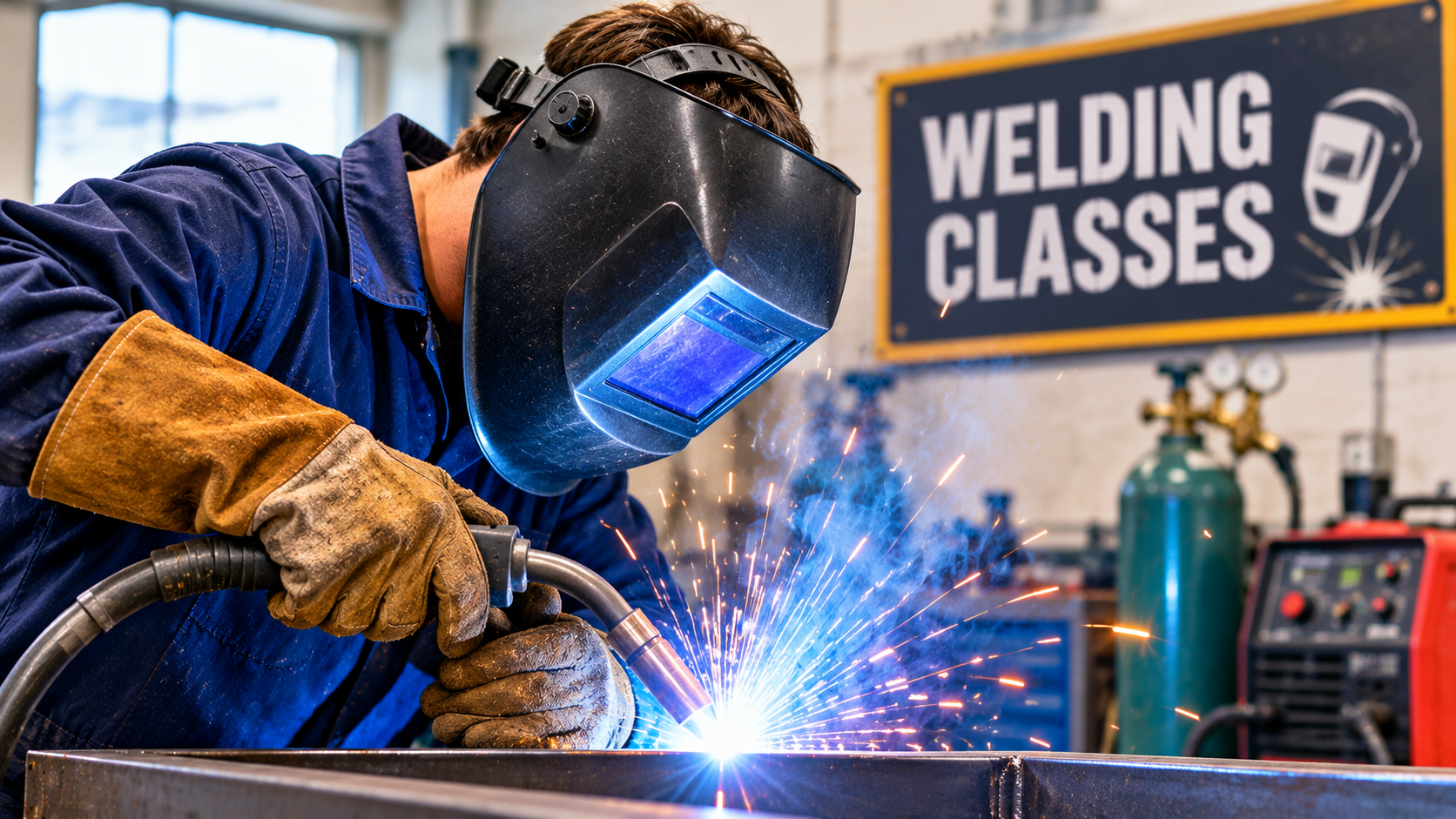

Key Takeaways
- Welding requires hands-on skills that videos cannot fully teach.
- Welding school provides supervised practice with real equipment.
- Instructors help students correct mistakes and improve technique.
- Safety training is essential in every welding environment.
- Students learn multiple welding methods through practical instruction.
- Hands-on training builds confidence for real workplace challenges.
- Welding school combines classroom learning with laboratory experience.
- Online lessons work best when combined with practical training.
Can You Really Learn Welding Online?
But what happens when you put on a welding helmet, pick up a welding gun, and try it yourself?
Suddenly, things feel different. You need to control your hands, understand the equipment, follow safety rules, and create a strong weld. Watching someone else do it is not the same as doing it yourself.
This is one of the biggest differences between online welding classes and attending a welding school.
Online courses can help you understand welding terms, equipment, and basic techniques. They are useful learning tools. However, welding is a skilled trade that requires real practice.
If you are thinking about becoming a professional welder, choosing the right training matters. A welding school gives you the chance to work with real equipment, learn from instructors, and build skills through hands-on experience.
Let's look at why attending welding school may be a better choice than relying on online welding classes alone.
Welding Is a Hands-On Skill That Requires Practice
Think about learning to ride a bicycle. You can watch videos explaining balance, steering, and braking. You can read about how a bicycle works. But eventually, you have to get on the bike and practice.
Welding works in much the same way.
Students need to learn how to:
- Hold and control welding equipment. Maintain the correct distance from the metal. Control the speed of their movements. Understand how heat affects different materials. Create clean and consistent welds. Recognize and correct welding mistakes.
At a welding school, students have opportunities to practice these techniques in a laboratory setting. They can apply what they learn in class instead of relying only on written lessons.
Online welding classes can explain the process, but they cannot replace the experience of holding welding equipment and practicing the skill yourself.
The bottom line: If you want to become a welder, you need to spend time actually welding.
Learn From Welding Instructors Who Can Guide You
When you watch an online welding video, you see what the instructor is doing. But the instructor cannot see what you are doing in your own workspace.
What if your welding angle is incorrect? What if your equipment is not adjusted properly? What if you are making the same mistake repeatedly without realizing it?
These problems can be difficult to identify when learning alone.
In a classroom and laboratory environment, instructors can observe your work and help you improve.
They can explain:
- How to position your body and welding equipment.
- How to select the proper welding settings.
- How to recognize common welding defects.
- How to improve your welding technique.
- How to follow proper safety procedures.
- How to develop better work habits.
Getting feedback while you practice can help you understand what you need to change.
It also gives you an opportunity to ask questions when something does not make sense.
Learning a skilled trade can feel challenging at first. Having someone available to answer questions and offer guidance can make the process more comfortable.
You do not have to figure everything out by yourself.
Safety Training Is More Than Watching a Video
That is why safety must be a major part of welding education.
Online welding classes can explain safety rules and show examples of protective equipment. However, students also need to understand how to apply those rules in an actual welding environment.
At welding school, safety instruction can help students learn how to:
- Select and properly use personal protective equipment (PPE). Protect themselves from physical hazards. Understand health risks associated with welding. Prevent fires in the welding shop. Handle hazardous materials. Understand the importance of proper ventilation. Maintain a safe work area. Use welding equipment correctly.
Austin Career Institute's welding curriculum includes a dedicated safety module covering accident prevention, physical hazards, health hazards, shop safety, fire prevention, hazardous materials, and protective equipment.
Students also study the safe handling of welding-related equipment and materials.
A safety-first mindset is something every aspiring welder should develop before entering the workforce.
Remember, learning to create a good weld is important. Learning how to protect yourself and others is just as important.
Work With Real Welding Equipment
A professional welding environment includes different machines, tools, supplies, and protective equipment. Students need to understand what these items do and how to use them properly.
Welding school provides an opportunity to become familiar with equipment used in the trade.
Depending on the training program, students may learn about:
- Welding machines and power sources. Electrodes and welding supplies. Welding guns and accessories. Oxyfuel cutting equipment. Plasma arc cutting equipment. Protective clothing and welding helmets. Equipment setup and adjustment. Fabrication and Blueprint reading
For example, students studying Shielded Metal Arc Welding (SMAW) need to understand how to select electrodes based on welding requirements.
They also need to learn how to assemble and adjust equipment before performing welds.
These are practical skills that require more than memorizing information.
Online lessons can introduce students to different machines and tools. However, working with the equipment helps students understand how everything fits together.
The more familiar you become with welding equipment, the more comfortable you can feel when learning new techniques.
Learn Different Welding Methods
That is why learning more than one welding method can be valuable.
A quality welding education should introduce students to important welding processes and explain how they are used.
Here are three common welding methods covered in Austin Career Institute's welding training.
Shielded Metal Arc Welding (SMAW)
This process uses a coated electrode to create an electric arc that melts metal and forms a weld.
Students learn how to:
- Identify SMAW equipment and accessories.
- Set up and adjust welding equipment.
- Select the correct electrodes.
- Understand different weld joints.
- Perform welds in different positions.
- Inspect and test welds.
Learning SMAW helps students understand important welding fundamentals.
Gas Metal Arc Welding (GMAW)
It uses a continuously fed wire electrode and shielding gas to create a weld.
Students need to understand the equipment, supplies, setup, and techniques involved in this welding process.
They also learn how to perform welds in different positions and on different joint types.
Flux-Cored Arc Welding (FCAW)
It is another important welding process that students can study as part of their technical training.
Understanding FCAW helps students become familiar with another method of joining metal.
Learning multiple welding processes provides a broader understanding of the trade.
Online welding classes can introduce these methods, but hands-on instruction allows students to practice the techniques and become familiar with the equipment.
Understand Welding Drawings, Symbols, and Metal Joints
Professional welders often need to understand drawings, symbols, measurements, and instructions before starting a project.
Imagine being asked to weld two metal pieces together. You might know how to operate the welding machine, but do you know where the weld needs to go, what type of joint is required, or what the finished product should look like?
This is where welding symbols and print reading become important.
At welding school, students can learn how to understand:
- Basic weld joints.
- Different weld types.
- Welding positions.
- Welding symbols.
- Mechanical drawings.
- Project specifications.
These topics help students understand how welding work is planned and completed.
For example, a welding symbol can communicate important information about the location and type of weld needed for a project.
Understanding these instructions can help prevent mistakes and improve the quality of the finished work.
Online courses can teach the meaning of welding symbols. However, combining classroom lessons with practical projects helps students connect what they read with what they do.
A welder needs both technical knowledge and practical ability.
Learn How to Inspect and Test Your Welds
A weld might look smooth on the outside, but appearance alone does not always tell the whole story.
Weld inspection and testing are important parts of welding education.
Students need to understand how to examine their work and identify problems that could affect the quality or strength of a weld.
Common welding problems may include:
- Cracks
- Porosity
- Poor weld appearance
- Incomplete fusion
- Improper weld size
- Other defects that affect weld quality
Learning how to recognize problems is an important step toward becoming a better welder.
At Austin Career Institute, welding instruction includes methods for inspecting and testing welds to assess their strength and integrity.
Students also learn about industry standards and certification processes related to welding methods.
This knowledge helps students understand that professional welding is about more than making two pieces of metal stick together.
It is about producing work that meets the requirements of the job.
Online lessons can explain different welding defects and show examples. But practical instruction gives students opportunities to connect those lessons to their own work.
Build Confidence Through Repetition
You might be worried about making mistakes, using unfamiliar equipment, or falling behind other students.
These feelings are normal when learning a skilled trade.
The good news is that welding is a skill that improves with practice.
The first time you perform a weld, it may not look the way you expected. Your movements may feel awkward, and you may need help understanding how to adjust your technique.
That does not mean you cannot become a good welder.
It means you are learning.
Hands-on welding classes give students opportunities to repeat techniques, learn from mistakes, and improve over time.
With practice, you can work toward developing:
- Better hand control
- More consistent welds
- Improved equipment knowledge
- Greater confidence using welding tools
- Better awareness of safety procedures
- Stronger problem-solving skills
Online videos can help you review techniques, but they cannot provide the same direct experience as working in a welding laboratory.
Confidence comes from understanding what you are doing and having the opportunity to practice it.
Every weld gives you another chance to learn something.
Classroom Learning and Online Training Can Work Together
In fact, the best learning experience can include both classroom instruction and online resources.
Online lessons are useful for reviewing information, learning technical terms, and preparing for classroom activities.
For example, you might watch a video about SMAW equipment before attending a laboratory session.
When you arrive at the school, you can apply what you learned by working with the equipment under supervision.
This combination can make lessons easier to understand.
Austin Career Institute's welding school uses several instructional methods, including:
- Classroom lectures. Laboratory instruction. Online training.
Some students understand a topic better after reading about it. Others need to see a demonstration or try the skill themselves.
Combining these learning methods provides different ways to understand welding concepts.
The important difference is that online training becomes part of a broader educational experience rather than the only way students learn.
For a hands-on trade like welding, that distinction matters.
What Should You Look for in a Welding School?
Before choosing a program, take time to understand what students will learn and how they will practice their skills.
Here are some important things to consider.
A Strong Safety Curriculum
Ask how the school teaches students to recognize hazards, use protective equipment, and maintain a safe working environment.
Hands-On Laboratory Training
A program should provide opportunities to work with equipment and apply classroom lessons.
Multiple Welding Processes
Learning different processes can help you understand more areas of the trade.
Qualified Instruction
Having access to guidance can make learning easier.
Welding Inspection and Testing
Quality control is an important part of welding work.
Clear Program Information
- Program length.
- Tuition and available payment options.
- Equipment and material requirements.
- Class schedules.
- Graduation requirements.
- Certificate requirements.
- Any available career services.
You should also ask what skills you are expected to demonstrate before completing the program.
Taking time to compare schools can help you make a more informed decision.
Is Welding School Worth It for Beginners?
In many cases, you do not.
A structured welding program can help beginners learn the basics and build their skills step by step.
You do not need to know how to operate a welding machine before starting your education.
Instead, you need a willingness to learn, follow safety procedures, practice, and improve.
Austin Career Institute's welding curriculum lists no prerequisites for its introductory welding modules.
Students begin by learning important safety practices and basic welding concepts before moving into more advanced techniques.
This type of learning structure can help beginners develop a strong foundation.
Welding school may also be a good option for people who:
- Want to learn a practical trade.
- Enjoy working with their hands.
- Prefer active work over sitting at a desk.
- Want to develop technical skills.
- Are interested in manufacturing or construction.
- Want to explore a career in the skilled trades.
- Are considering a career change.
You do not have to be an expert to get started.
The purpose of training is to help you develop the knowledge and skills needed to take the next step toward a career in welding.
Take the Next Step Toward Your Welding Career
Online welding classes can be helpful for understanding basic concepts, reviewing lessons, and learning about different welding processes.
However, online instruction alone has limitations.
Welding is a practical trade. You need opportunities to use real equipment, practice techniques, understand safety procedures, and receive feedback on your work.
Attending welding school provides a structured environment where you can combine classroom learning with hands-on laboratory experience.
At Austin Career Institute, the Welding Certificate Program is designed to introduce students to important welding skills and industry practices.
The curriculum includes:
- Welding safety and accident prevention.
- Personal protective equipment.
- Oxyfuel gas cutting.
- Plasma arc cutting and gouging.
- Shielded Metal Arc Welding (SMAW).
- Gas Metal Arc Welding & Fabrication (GMAW).
- Flux-Cored Arc Welding(FCAW).
- Gas Tungsten Arc Welding (GTAW).
- Equipment setup and adjustment.
- Welding joints, positions, and symbols.
- Weld inspection and testing.
Students also learn about industry standards and certification processes related to welding methods.
If you are ready to explore a career in the skilled trades, consider whether hands-on welding education is the right choice for you.
You do not have to figure out every step of your career today. Start by learning about your options and finding a training program that matches your goals.
Your future in the skilled trades can start with learning one skill at a time.
Contact us to learn more about training opportunities and take the next step toward your future.
Frequently Asked Questions
Can I learn welding through online welding classes?
Is welding school better than learning welding online?
Do I need previous welding experience to attend welding school?
What will I learn in welding classes
What is the difference between SMAW, GMAW, FCAW and GTAW?
- SMAW: Uses a coated electrode and is commonly called stick welding.
- GMAW: Uses a continuously fed wire electrode and is commonly called MIG welding.
- FCAW: Uses a tubular wire filled with flux.
- GTAW: Uses a small torch to preheat metal before adding filler metal.
Each process has different equipment, techniques, and applications.